
A sales representative sits on a video call, navigating a complex pitch. The prospect asks a highly specific question about integration timelines or compliance protocols.
The representative pauses, promises to follow up, and later scours the company blog for a link to send. They find three articles on broad industry trends and zero answers to the prospect’s actual question.
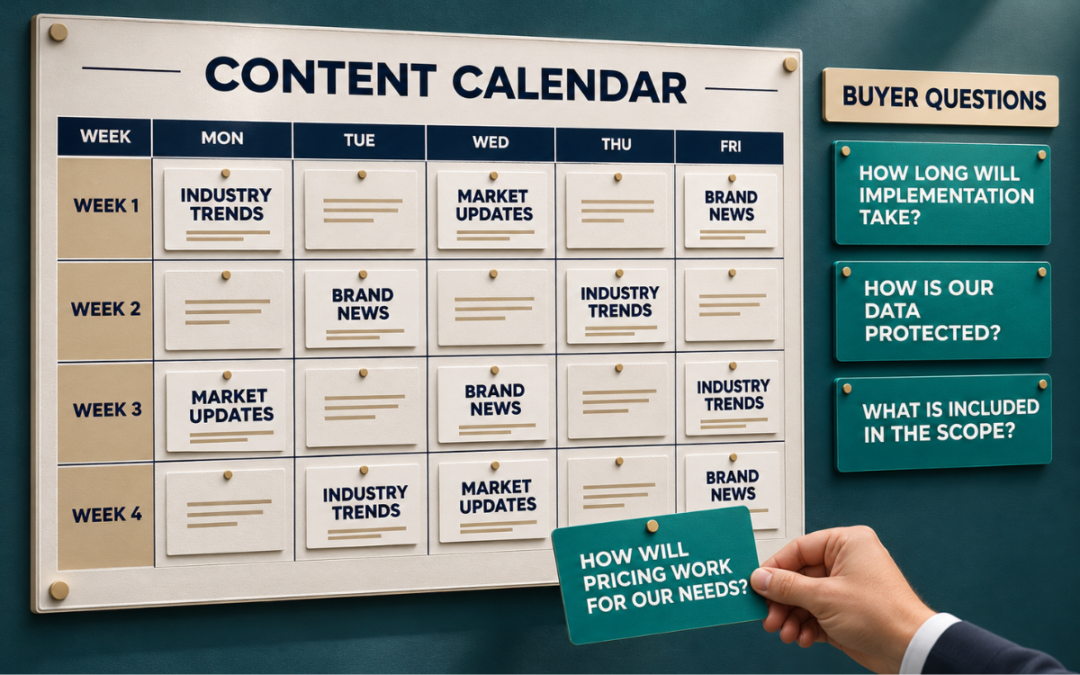
Use this illustrative scenario to test your calendar. Can a representative find a useful answer to the questions buyers ask before signing, or only broad category explainers?
The disconnect between search volume and sales reality
Marketing teams naturally gravitate towards Search Engine Optimisation (SEO) tools to plan their months. If a term has high search volume, it gets a slot on the calendar. But this approach creates a blind spot.
The questions that hold up a deal rarely have massive search volume. A prospect deep in the pipeline is not searching for basic definitions.
They are asking your sales team why your implementation takes twice as long as a competitor’s, or how your platform handles specific data privacy regulations. When your content ignores these B2B buyer objections, you leave your sales team to answer complex questions from scratch every single time.
How to map content to real buyer hesitation
To fix this, you need to dedicate a significant portion of your publishing effort to sales enablement content. This means producing assets designed specifically to answer the questions that cause friction in the late stages of a deal.
Instead of guessing what to write, look at where deals stall.
| Content type | Source of inspiration | Goal of the asset |
|---|---|---|
| Search-led content | Keyword research tools | Attract new visitors to the website |
| Sales enablement content | Call recordings and sales emails | Overcome specific B2B buyer objections |
Good content begins by listening to the business, its philosophy, requirement, objective, and message. When we approach content planning, we look for the exact phrases prospects use when they push back on price, timeline, or scope. By documenting these exact hesitations, you create a brief that addresses reality rather than an abstract marketing persona.
The internal feedback loop you need to build
You cannot write effective sales enablement content if marketing and sales operate in separate silos. The marketing team needs raw material, and the sales team holds it.
Set up a simple system to capture this information. Ask sales to contribute recurring questions and approved explanations, with personal and confidential information removed. Use call recordings only where their use is authorised.
Those long emails are usually draft blog posts hiding in plain sight. If a subject-matter expert has already spent an hour explaining a technical nuance to one client, check whether that explanation can be refined for shared use. Get technical and disclosure approval before publishing it.
This approach prevents avoidable rework. It also ensures your writing sounds human and addresses a genuine business tension, rather than reading like a generic encyclopaedia entry.

Metrics that show what actually closes deals
When you shift your focus towards answering specific sales questions, your metrics must change too. A highly technical article addressing a niche regulatory concern might only get fifty page views a year. If those fifty views belong to procurement managers who then approve a high-value contract, the asset has done its job perfectly.
FAQ
What is the difference between marketing content and sales content?
Marketing content generally focuses on attracting a broader audience and building brand awareness, often using SEO. Sales content is highly specific, designed to answer direct questions, overcome objections, and help representatives close active deals.
How do we find the right questions to answer?
Speak directly to your sales and customer success teams. Review call recordings, look at the questions asked during product demonstrations, and analyse the email threads where deals typically stall.
Should sales enablement content be public on the blog?
Choose the format by audience and disclosure permission. General approved explanations can be public; sensitive pricing, security or client details may need controlled access. A gated page is not a substitute for permission to disclose.
How often should we update these assets?
Review them whenever your product, service, or pricing changes. Outdated technical information creates more friction than having no content at all, so regular content hygiene is essential.
Track sales reuse alongside buyer feedback, follow-up questions and movement through the decision process. Reuse is a useful signal, not proof that an asset caused a deal to close.
By capturing the real questions your buyers ask, you turn your blog from a static publication into an active tool for revenue. If you are struggling to align your marketing output with your sales reality, explore our content strategy services to build a calendar around the questions your buyers need answered.