
You know the feeling when you read a piece of text, and your brain immediately flags it? It is not because of a spelling mistake or a grammatical error. In fact, it is usually because the grammar is too perfect. The sentences flow with a terrifying, rhythmic predictability. It is the literary equivalent of elevator music—smooth, inoffensive, and entirely forgettable.
This is the hallmark of the raw AI draft.
With the rise of generative AI, we have all become incredibly efficient at producing first drafts. We can generate a thousand words on complex logistics or B2B SaaS strategies in under thirty seconds. But there is a massive difference between a completed draft and a compelling read.
If you are simply hitting publish on what the prompt spit out, you are not building authority. You are just adding to the digital noise.
Here is how to take those beige, machine-made foundations and turn them into something that actually connects with a human reader.
The anatomy of the beige draft
Before we can fix a generic draft, we need to recognise its tells. AI has a distinct scent. Once you learn to spot it, you cannot unsee it.
Machines love symmetry. They write in neat, medium-length sentences. They adore passive voice because it feels safe and objective. And they have a bizarre obsession with certain transition words. If your draft is littered with “moreover,” “furthermore,” “it is important to note,” or “in today’s fast-paced digital landscape,” you are dealing with a classic AI template.
Another dead giveaway is the lack of opinion. AI is programmed to be a neutral bystander. It synthesises existing information but rarely takes a stand. It will tell you that “some experts prefer strategy A, while others advocate for strategy B.”
But your readers do not want a fence-sitter. They want a guide. They want to know which strategy actually works when the pressure is on.
The three-step humanisation framework
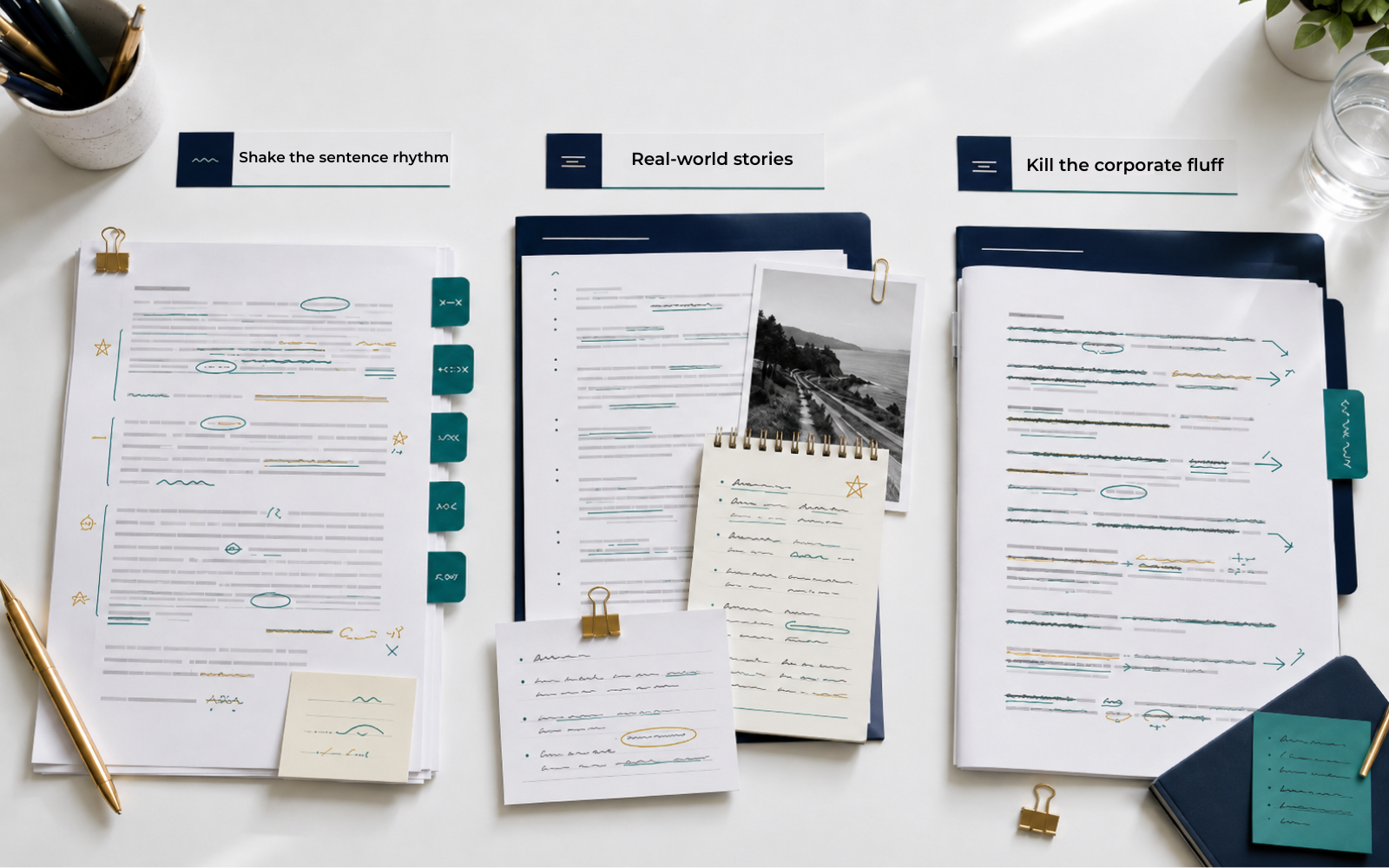
Transforming an AI draft into high-performing content is not about rewriting every word from scratch. It is about systematically injecting the elements that a machine cannot replicate.
1. Shake up the sentence rhythm
AI writes with a monotonous cadence. Human speech, on the other hand, is jagged. It has pauses, sudden stops, and bursts of energy.
To fix this, use the “music test.” Read your content aloud. If you find yourself breathing at exactly the same intervals, your rhythm is flat.
Mix short, punchy sentences with longer, descriptive ones. Use single-word sentences for emphasis. Seriously. It breaks the visual and mental monotony.
2. Inject real-world scars and stories
A machine cannot share a personal mistake. It has never stayed up until 3:00 AM fixing a broken server or lost a client because of a misplaced decimal point.
This is where you bring in your own expertise—or your brand’s collective history.
Instead of saying “effective project management requires clear communication,” tell a quick story. Recall the time a simple misunderstanding about a deadline led to a frantic weekend of damage control. Suddenly, the abstract concept of “communication” becomes a tangible, relatable lesson.
3. Kill the corporate fluff
AI loves filler words that add bulk but zero value. It “delves into” topics, “pioneers” solutions, and “fosters” collaboration.
Strip these out. Replace passive phrasing with active, direct language. If a sentence works without a word, delete it.
For instance, change “It is crucial to ensure that your team is aligned” to “Align your team.” It is sharper, faster, and far more authoritative.
The transformation in action
Let’s look at how a simple paragraph changes when we apply these rules. Imagine we are writing a piece on remote work culture or business efficiency.
| The raw AI draft | The humanised masterpiece | Why it works |
|---|---|---|
| In today’s fast-paced corporate environment, fostering a robust remote work culture is of paramount importance. Organisations must prioritise open communication channels to ensure employee satisfaction and productivity. | Remote teams do not drift apart because of distance; they drift because of silence. If you are not actively building a culture of casual chat, your Slack channels will turn into a digital graveyard. | We swapped the generic “paramount importance” for a sharp, relatable warning. The tone shifted from a lecture to an observation. |
| It is vital to leverage advanced technological solutions to streamline your inventory management processes, thereby optimising operational efficiency. | Stop counting boxes by hand. If your inventory software does not communicate with your checkout counter in real time, you are losing money on every single sale. | We replaced clinical jargon with a direct, painful business reality that readers actually care about. |
Designing a workflow that protects your voice
Using AI is not cheating, but relying on it to do your thinking is. The secret to scaling your content without losing your voice is to change when you use the machine.
Do not ask AI to “write a blog post about X.” That is a recipe for mediocrity. Instead, use it as a sparring partner at specific stages of your workflow:
- The outline stage: Ask the AI to find gaps in your initial outline. Ask: “What perspectives am I missing in this setup?”
- The research stage: Use it to summarise long reports or extract key data points.
- The editing stage: Once you have written your human draft, use AI to check for clarity or suggest alternative headlines.
By keeping the actual writing process firmly in human hands, you ensure that the core perspective remains uniquely yours.
Moving beyond the template
The internet does not need more content. It needs better context.
AI can give you the raw facts, the standard definitions, and the structured bullet points. But it cannot give you the perspective that comes from actually doing the work.
The next time you generate a draft, do not treat it as a finished product. Treat it as raw clay. It is your job to shape it, carve out the rough edges, and leave your fingerprints on the final piece.
Because at the end of the day, people do not buy from algorithms. They buy from people who make them feel understood.