
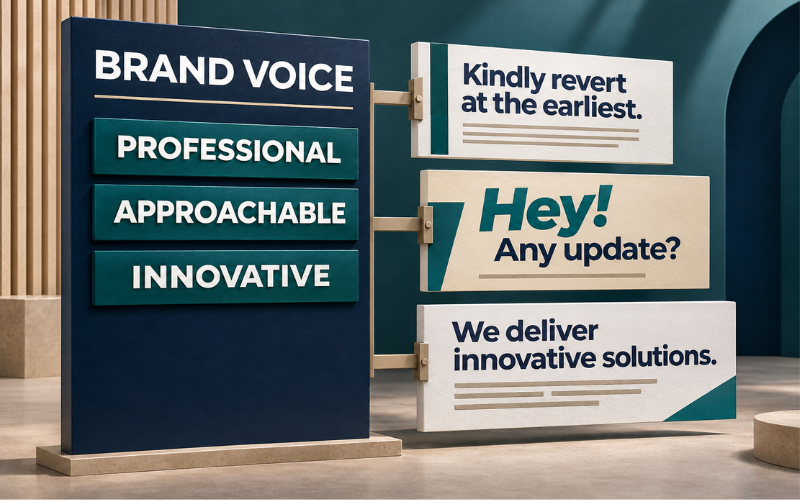
You hand a new writer your brand deck. Page four dictates your company sounds: u201cprofessional, approachable, and innovative.u201d A week later, the draft arrivesu2014grammatically perfect, entirely polite, and completely forgettable.
Use this illustrative scenario to test your own guidelines. Companies spend months defining visual identity but leave written identity to vague descriptors. The result is content debt: a growing pile of blogs, emails, and whitepapers that could belong to any competitor.
The problem with being professional and approachable
If your brand voice guidelines rely on three generic adjectives, you have a mood board, not a voice. Words like “authoritative” or “friendly” mean different things to different people. A junior copywriteru2019s “friendly” might include emojis, while a senior subject-matter expertu2019s version might simply mean removing technical jargon.
For a B2B team in a regulated sector, this ambiguity becomes a review problem. The intention is good, but execution fails because adjectives leave too much room for interpretation. Writers need boundaries.
They must know what happens when a topic is dense or a customer is frustrated. Without specific rules, contributors default to the safest, most neutral tone, stripping your content of real personality.
Why AI amplifies weak brand documentation
This ambiguity becomes a serious liability when introducing Artificial Intelligence (AI) into your workflow. Ask a Large Language Model (LLM) to be “innovative” without examples, and check whether the result expresses your actual point of view or merely sounds enthusiastic.
Keep a human accountable for the context, accuracy and editorial choices, whether the first draft comes from AI or a writer. To get useful results from AI or a human writer, your brand voice guidelines must provide specific constraints.
You must define not just what you are, but what you are not. Without this clarity, AI output feels polished but fundamentally empty, blending in entirely with the rest of the internet.
Building a framework writers can actually use
A useful voice document acts as a decision framework. Instead of listing adjectives, build a “this, but not that” structure to create immediate guardrails for anyone creating content.
| Situation | Vague wording | Illustrative rewrite |
|---|---|---|
| Website introduction | We deliver innovative solutions. | We help procurement teams compare supplier evidence before choosing. |
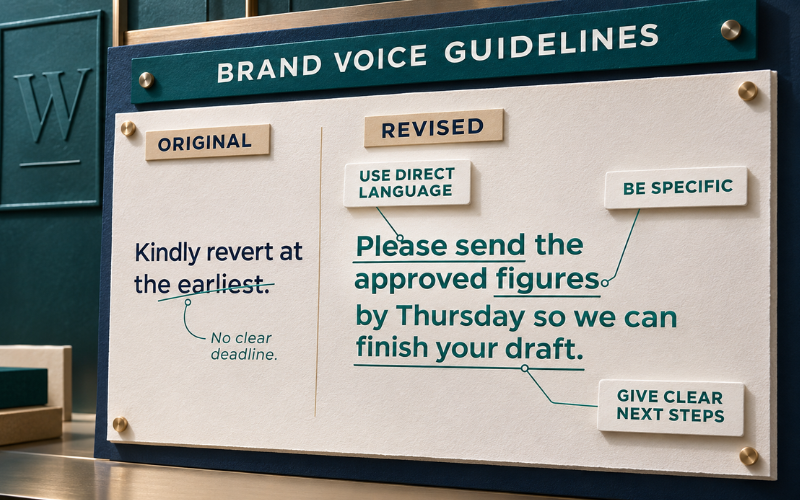
| Customer email | Kindly revert at the earliest. | Please send the approved figures by Thursday so we can finish your draft. |
| Sensitive update | We apologise for any inconvenience caused. | Your report is delayed. We will confirm the revised delivery time by 3 pm. |
To make this actionable, include side-by-side brand tone of voice examples. Show a poorly written sentence, then the exact same sentence corrected for your brand.
When writers see your style mechanics applied to real scenariosu2014like a product update, apology email, or technical whitepaperu2014they stop guessing and start executing. Clear constraints prevent a junior writer from using excessive exclamation marks to sound “friendly,” and stop a subject-matter expert from using passive voice to sound “professional.”
Turning abstract ideas into practical content
Good content begins by listening to the business, its philosophy, requirement, objective, and message. At WordBerries, we know capturing a distinct voice requires digging into how your experts actually speak and think.
We look at how you handle Search Engine Optimisation (SEO) without sounding like a keyword spreadsheet, and examine regulatory constraints to ensure compliance does not destroy readability. Alignment on scope, structure, and format prevents avoidable rework, so agree the voice examples and review criteria before drafting.
FAQ
What should comprehensive brand voice guidelines include?
Effective guidelines go beyond adjectives to include your core message, audience personas, grammar rules, negative constraints (“what we are not”), and concrete before-and-after writing examples.
How does tone differ from voice?
Your voice is your consistent brand personality. Your tone adjusts based on the situation, such as sounding empathetic in a support email but energetic in a product launch.
Why is AI struggling to capture our company voice?
AI tools default to average, predictable language. Without detailed guidelines providing specific constraints and examples, AI cannot replicate the nuance, context, or unique perspective of your business.
How often should we update our voice documentation?
Review your documentation annually or whenever your business undergoes a major shift, such as entering a new market, changing your target audience, or launching a significantly different product line.
Can a regulated B2B company have a distinct voice?
Yes. Operating in a regulated sector means you must be accurate, not boring. Simplifying technical information and removing corporate jargon helps build trust and creates a highly recognisable, professional voice.
Whether managing in-house experts or external contributors, documentation gives contributors a shared reference for consistent publishing. A strong voice is not about sounding clever; it is about sounding reliably like yourself every time you publish. If you are ready to turn abstract branding into a practical content system, explore how we work to give your next brief a more usable voice reference.