

We are natural-born hoarders when it comes to the internet. We publish a blog post, watch it float into the digital ether, and immediately start planning the next one. It feels productive. More pages must mean more visibility, right?
Not quite.
Over time, this relentless creation gives rise to a digital graveyard. You end up with five different articles on the exact same topic, three outdated product announcements from 2019, and a handful of thin, forgotten guides that haven’t seen a visitor since the pre-pandemic era. This isn’t just harmless clutter. It is actively dragging down your search rankings.
In the SEO world, sometimes the best way to grow is to cut. Here is how to prune your content garden so your best work can finally breathe and rank.
Why your website is carrying dead weight
Think of your website like a physical shop. If a customer walks in and has to sift through boxes of expired stock and dusty brochures just to find your bestseller, they will probably leave. Search engines do the same thing.
When Google sends its crawlers to your site, it allocates a specific amount of time and energy—known as a crawl budget. If your site is bloated with low-quality, outdated pages, the crawlers waste their energy on the junk. They might miss your high-value, high-converting pages entirely.
Then there is the issue of keyword cannibalisation. When you have multiple pages targeting the same search query, you are essentially competing against yourself. You confuse the search engine, dilute your link equity, and split your traffic. By trimming the excess, you focus all your SEO power onto a few elite pages.

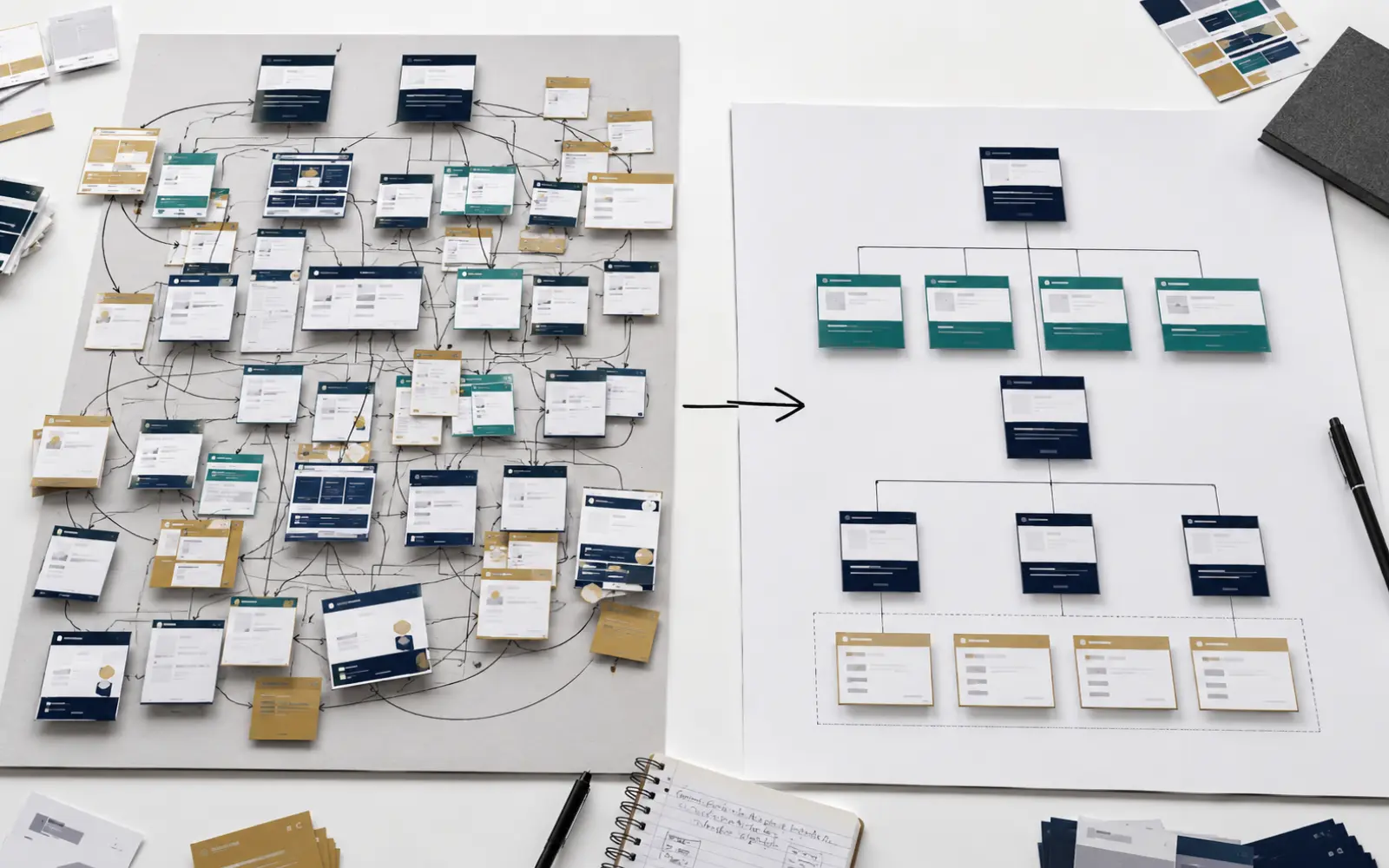
Four content pruning strategies to reclaim your search visibility
Getting rid of content can feel terrifying. But when you approach it with a clear, strategic framework, you aren’t destroying your hard work—you are consolidating its power. Here are the four primary strategies to clean up your digital library.
1. The consolidate and conquer approach
Instead of hosting three short, mediocre articles about “SME tax tips”, you merge them into one comprehensive, authoritative powerhouse.
Let’s say a boutique financial services firm, let’s call them Apex Advisory, has four separate blogs written between 2021 and 2024. Each covers a tiny slice of corporate tax planning. None of them ranks on the first page. By combining the best insights, updating the data, and publishing it as a single “Ultimate Guide to Corporate Tax Planning,” they create a high-value asset.
You redirect the old URLs to this new master page. Suddenly, Google sees a highly authoritative, well-structured resource rather than four thin pieces. Your rankings climb because you have solved the reader’s intent in one single stop.
2. The swift, clean cut
Some content simply does not deserve a second chance. It sounds harsh, but it is the truth.
We are talking about old event invites, press releases for products you no longer sell, or seasonal campaigns from five years ago. These pages offer zero value to a modern searcher. They do not have backlinks, they do not get traffic, and they do not align with your current business goals.
For these pages, the solution is simple: delete them. Ensure you return a clean 410 (gone) or 404 status code so search engines know to remove them from their index. Removing this dead weight instantly cleans up your site architecture and frees up your crawl budget.
3. The strategic redirect
Sometimes you have a page that is outdated but still has high-quality backlinks from external sites. Deleting it outright would mean throwing away valuable link equity.
In this scenario, you use a 301 redirect. You point the old, outdated URL toward a highly relevant, active page on your site.
For instance, if you have an old case study from a client transition that is no longer relevant, but a major industry blog linked to it back in 2020, do not delete it. Redirect that URL to your main services page or a newer, highly successful case study. You preserve the digital authority (the “link juice”) and pass it along to a page that actually drives conversions.
4. The diamond-in-the-rough polish
These are the pages that are sitting on the cusp of greatness. They rank on page two or three of Google, get decent impressions, but struggle to attract actual clicks.
This content does not need to be deleted or merged; it just needs a fresh coat of paint. Often, a few strategic tweaks can push it onto the coveted first page.
To polish these hidden gems:
- Update outdated statistics and references to make them current.
- Rewrite the meta title and description to make them more enticing.
- Add fresh, engaging formats, such as a quick video summary or an interactive checklist.
- Match the search intent more closely by answering common questions directly.
By investing a fraction of the time it takes to write a new post, you can unlock a massive wave of organic traffic.
A simple framework for categorising your content
You do not want to start deleting pages blindly. A structured, data-driven approach keeps you from making costly mistakes.
Before you touch a single page, pull your data from Google Analytics and Google Search Console. Look at traffic, backlinks, and conversion rates over the last 12 months.
Here is a simple matrix to help you categorise your library:
| Content status | Metric signal | Recommended action |
|---|---|---|
| High traffic, high conversions | Consistent views, driving leads/sales | Protect & monitor (Leave it alone, check quarterly) |
| Low traffic, high backlinks | Barely any visitors, but has external links | Redirect (301) to a relevant, high-performing page |
| High impressions, low clicks | Ranks on page 2-3, low click-through rate | Polish & update (Optimise titles, refresh data) |
| Zero traffic, zero backlinks | No views, no external links, outdated topic | Delete (404/410) to clean up your site architecture |


Shifting from a hoarding mindset to a healthy garden
It is easy to measure content success by volume. We love pointing to a blog with hundreds of articles as a badge of honour. But in the modern search landscape, quality is the only metric that truly moves the needle.
Pruning your content can feel incredibly counterintuitive. It feels like you are erasing your hard work. But by letting go of the pages that no longer serve your audience, you give your best ideas the space, authority, and attention they need to thrive.
Treat your website like a living garden. Water the plants that are blooming, prune the branches that have withered, and do not be afraid to clear the weeds. Your search rankings—and your readers—will thank you for it.