Remember that cringe-worthy trend your brand jumped on last year? The one where everyone was doing those slightly awkward, overly-polished “day in the life” reels? Yeah, your audience has already moved on. They’re now deep into raw, unedited snippets that feel more like a text from a friend than a production. The gap between what your audience cares about right now and what your content calendar is still serving is growing wider by the day. It’s not just about missing trends; it’s a fundamental misalignment that’s making your content feel obsolete before it even publishes. Let’s talk about why this happens and how to build a system that actually keeps pace.
The content treadmill is broken
Most content strategies are built on a flawed premise: that audience needs are relatively stable. We do our research, create personas, and then produce content based on that static snapshot. But your audience isn’t a photograph; they’re a live stream. Their problems shift with the economy, their questions evolve with new tools, and their attention wanders with every new platform update.
The result? You’re optimising for a world that no longer exists. You’re writing detailed how-to guides for a tool that just got superseded by an AI feature. You’re crafting thoughtful LinkedIn posts about industry challenges while your audience is having heated, genuine debates in a niche Discord server. Your content calendar is a meticulously planned route, but the terrain is changing under your feet.
Why your content process can’t keep up
It’s not laziness. It’s systemic. Three core reasons your content lags:
1. you’re listening to echoes, not the source
Many brands rely on last quarter’s survey data or annual review feedback. By the time that information is analysed and turned into a content brief, the conversation has moved on. You’re reacting to echoes. The real signal—the raw, unfiltered questions in your support tickets, the slang in your social comments, the sudden spike in searches for a new term—gets filtered out or ignored as “noise.”
2. your production cycle is a relic
A six-week blog production cycle made sense in 2015. It doesn’t now. That process assumes you have time to research, draft, review, optimise, and publish. In that time, a new competitor can emerge, a regulation can change, or a cultural moment can pass. The gap between insight and output is where relevance dies.
3. you’re measuring the wrong things
“Engagement” and “page views” are lagging indicators. They tell you what was popular, not what is urgent. By the time a topic trends in your analytics, the peak conversation is over. You’re celebrating yesterday’s news while your audience is already tomorrow’s problem.
How to build an adaptive content engine
Catching up isn’t about working faster. It’s about building a different system—one that’s designed for flux, not permanence.
Shift from campaigns to continuous conversations
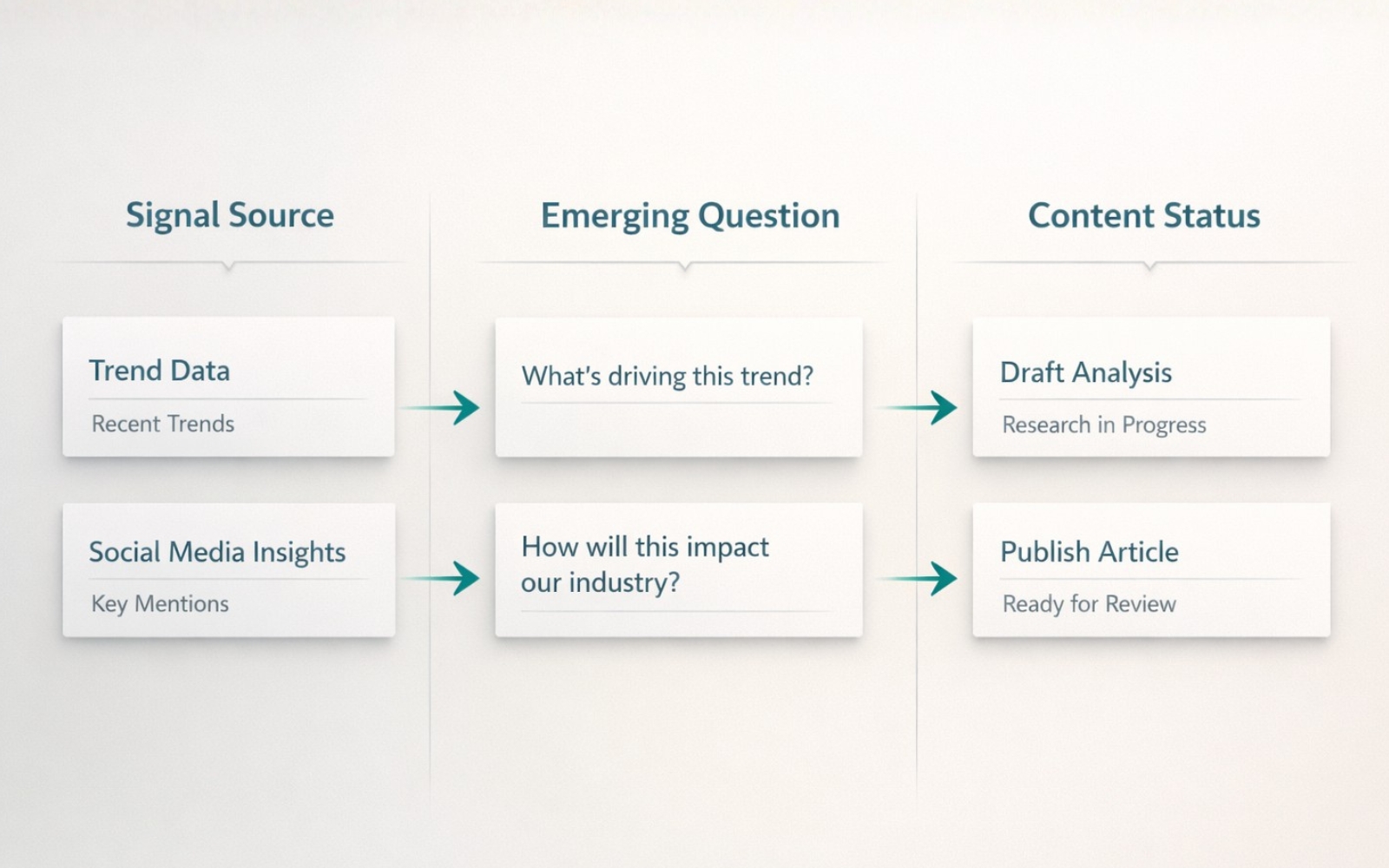
Stop thinking in quarterly “content buckets.” Start thinking in weekly “signal checks.” This means dedicating a small, cross-functional team (maybe just one person from marketing, one from support, one from sales) to spend 2-3 hours per week on pure listening:
- scanning niche forums and community threads (not just your own)
- reviewing the latest 50 support tickets for emerging language
- tracking competitor comment sections for unanswered questions
- noting new terminology in industry newsletters
This isn’t a formal report. It’s a raw, bullet-point list of “what’s bubbling up right now.” That list directly feeds your top-priority content for the next 7-10 days.
Embrace modular, not monolithic, content
The six-week blog is a dinosaur. Instead, create content in atomic units—a core insight, a key statistic, a single actionable tip. Then, assemble those atoms differently for different platforms and moments.
- That one sharp insight about a new regulation becomes a LinkedIn carousel.
- The actionable tip turns into a 30-second Instagram reel.
- The statistic fuels a Twitter thread.
- The deeper explanation stays as a “living” guide on your site, updated in real-time as the landscape shifts.
This approach means you’re not waiting for the “perfect” long-form piece. You get micro-content out in hours, not months, meeting the audience where the conversation is happening now.
Close the loop with real-time feedback
Your content’s job isn’t done at “publish.” It’s done when it provokes a response. Actively engineer feedback loops:
- End short-form videos with a specific, low-effort question (“What’s your biggest hurdle with this?”) not a generic “Thoughts?”
- Pin a comment on your LinkedIn posts asking for one concrete example from the reader’s experience.
- Use poll stickers in Stories to validate assumptions before you write the long-form piece.
This turns your audience from passive consumers into active collaborators. You’re not just guessing what they need; you’re asking, listening, and iterating in public. The content that follows is inherently more aligned because it’s co-created.
The mindset shift: from publisher to participant
Ultimately, catching up requires a fundamental identity change. You’re not a broadcaster on a schedule. You’re a participant in an ongoing industry dialogue. Your content calendar is less of a rigid itinerary and more of a flexible itinerary—always ready to detour to where the real conversation is happening.
This means giving your team permission to:
- Pause a pre-scheduled post to address a breaking industry update.
- Use platform-native formats (like Notes or Twitter threads) for quick takes without “perfect” polish.
- Admit you don’t have all the answers and frame content as a starting point for discussion.
Your audience’s evolution isn’t a hurdle; it’s your most valuable source of insight. The brands that thrive in 2026 won’t be the ones with the biggest content calendars. They’ll be the ones with the shortest feedback loops, the courage to abandon outdated formats, and the humility to let their audience guide the way. Stop trying to outpace change with more content. Start aligning with it by making your content process more like the world it serves—dynamic, responsive, and human-first.