

You know that feeling when you check your bank balance and realise those small, regular spends on coffee, subscriptions, and “just one more thing” have quietly added up to a mountain of debt? That sinking, “how did this happen?” moment? Now, imagine that feeling, but for your content. It’s called content debt, and it’s probably draining your marketing ROI without you even realising it.
We talk a lot about creating more—more blogs, more posts, more videos. But we rarely talk about the hidden cost of the content we’ve already created. The outdated guides. The generic blog posts ranking for nothing. The campaign assets that confused more than they converted. This isn’t just clutter; it’s active debt. It costs you in search visibility, brand trust, and team sanity. Let’s break down what content debt really is, why it’s so dangerous, and a practical plan to start paying it down.
What exactly is content debt?
Think of it like technical debt in software. It’s the accumulation of quick fixes, shortcuts, and misaligned pieces created over time that now make everything slower, more expensive, and less effective to maintain. In content terms, it’s every piece that:
- Was created without a clear goal or audience in mind.
- Is factually outdated but still live.
- Contradicts your current messaging or brand voice.
- Sucks up crawl budget without providing value.
- Confuses your sales team or misleads potential customers.
- Was made for a platform algorithm that no longer exists.
Every piece of content you publish is either an asset or a liability. Content debt is the liability pile. And just like financial debt, it accrues interest—in the form of poor SEO performance, diluted brand authority, and wasted creative energy.
Why your “busy” content calendar is building debt
Most teams are in a perpetual cycle of creation, often because “we need to be active.” But activity isn’t strategy. Here’s how that well-intentioned busyness creates debt:
1. The “just get it live” trap
When the priority is volume over value, you publish content that’s thin, repetitive, or only tangentially related to what your audience actually needs. This content doesn’t rank, doesn’t engage, and doesn’t convert. But it lives on your site, eating up resources and sending weak signals to search engines.
2. Platform-first, not people-first thinking
Chasing a TikTok trend with a LinkedIn audience, or forcing every topic into a carousel format, creates content that feels off-brand and inauthentic. It might get a temporary spike, but it doesn’t build lasting trust. This mismatch is a form of debt because it erodes the consistency your audience relies on.
3. The “set and forget” myth
Publishing a “2022 Guide to GST” in 2025 isn’t just outdated—it’s actively harmful. It shows up in searches, someone clicks, and you look out of touch. It damages credibility. Every outdated piece is a trust withdrawal you never repaid.
4. Siloed creation without a central strategy
When different teams or creators publish without a unifying content strategy or topic cluster model, you end up with conflicting messages, keyword cannibalisation, and a fragmented brand story. This confusion is a high-interest debt that makes future content less effective.
The real cost of ignoring content debt
- SEO stagnation: Google rewards expertise, authoritativeness, and trustworthiness (E-E-A-T). A site full of thin, outdated, or contradictory content struggles to build this. You’re actively working against your own rankings.
- Wasted budget: Your content team spends hours creating new pieces, but a significant portion of your site traffic bounces because they landed on an irrelevant or old piece first. That’s paid labour for no return.
- Sales enablement failure: Your sales team sends prospects a link to a “key article” only for it to be two years old or not reflect your current pricing. It undermines their credibility and lengthens sales cycles.
- Brand dilution: Inconsistent voice, mixed messages, and poor-quality pieces make your brand feel unprofessional and unreliable. It’s a quiet erosion of equity.
How to start paying down your content debt: a four-step plan
Paying down content debt isn’t about deleting everything and starting over. It’s a strategic process of audit, prune, rebuild, and systemise.
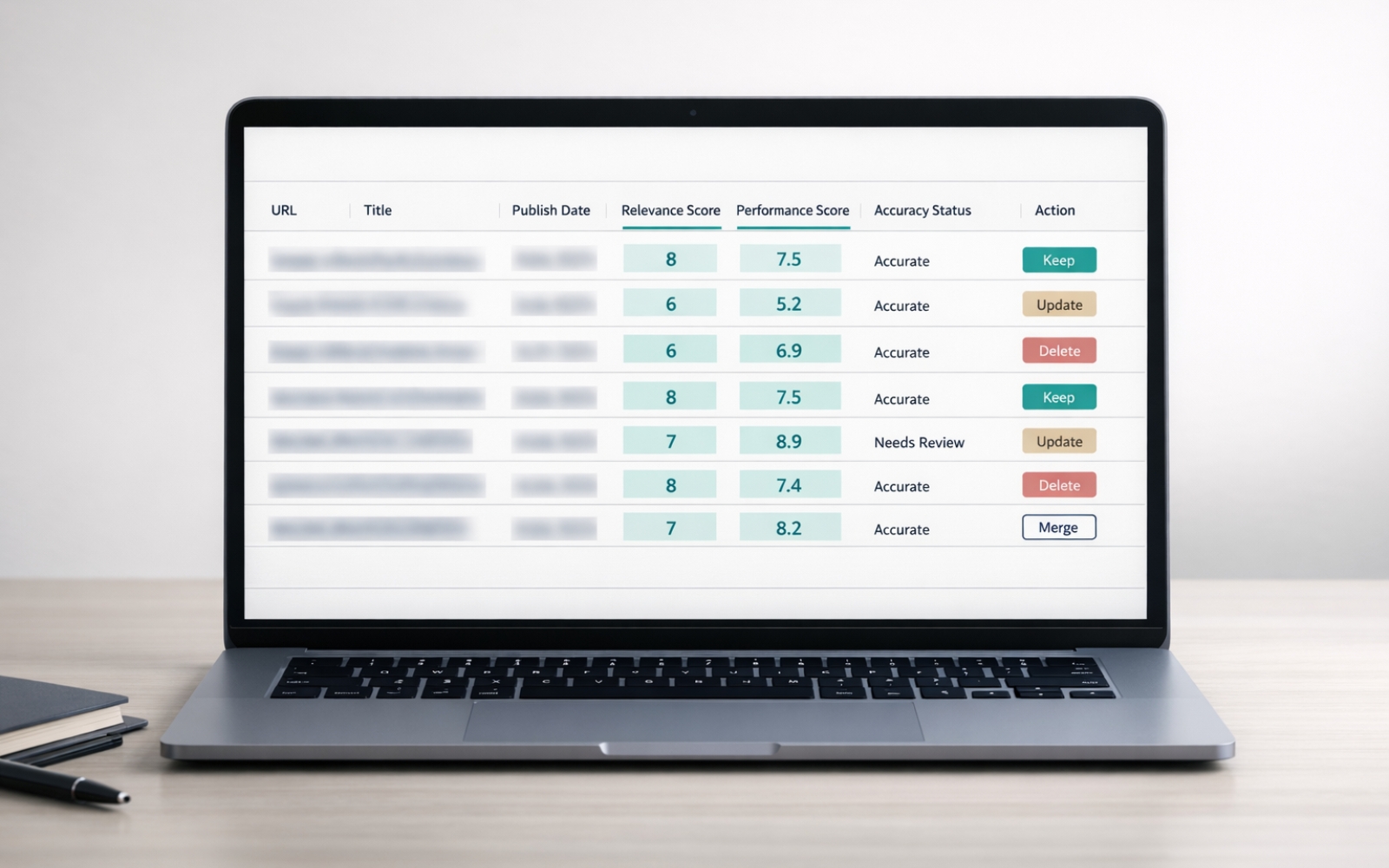
Step 1: Conduct a full content audit (the “balance sheet”)
You can’t manage what you don’t measure. Use a simple framework to score every piece of core content (blogs, guides, major landing pages) on:
- Relevance: Does it align with our current business goals and audience needs?
- Performance: What are its traffic, engagement, and conversion metrics over the last 12 months?
- Accuracy: Is all information, data, and pricing up to date?
- Quality: Does it reflect our current brand voice and provide genuine value?
Step 2: Prioritise and prune (make the tough calls)
Based on your audit, sort your content into four quadrants:
| High Performance & Relevant | Low Performance & Relevant |
|---|---|
| Keep & Promote These are your golden assets. Update them periodically and use them in campaigns. | Update & Repurpose These have potential but need a refresh—new data, updated examples, better SEO. |
| High Performance & Irrelevant | Low Performance & Irrelevant |
|---|---|
| Archive or Redirect If it ranks but isn’t relevant, consider a 301 redirect to a relevant piece or archive it. | Delete This is your high-interest debt. Remove it. It’s costing you crawl budget and providing zero value. |
Be ruthless with the “low performance & irrelevant” pile. Deleting it is a direct ROI win.
Step 3: Rebuild with intent (the “new asset” strategy)
Don’t just refill the empty spaces. For every piece you delete or update, have a plan for a new, strategic piece that:
- Targets a specific, high-intent keyword or audience question.
- Fits into a clear topic cluster (a pillar page with supporting subtopics).
- Has a defined business goal (e.g., “this piece is for lead generation,” or “this builds awareness for our new service line”).
- Is created with a clear repurposing plan from the start (e.g., “this blog will become a LinkedIn carousel series and a webinar script”).
This turns your content creation from a cost centre into an investment in a valuable, interconnected asset library.
Step 4: Build a maintenance system (prevent future debt)
Content debt will accumulate again unless you build guardrails. Implement:
- A quarterly content review cycle for your top-performing and cornerstone pieces.
- A publishing checklist that includes “Is this aligned with our current strategy?” and “Is this factually up to date?”
- Clear ownership for content clusters—someone is responsible for the health of that entire topic area.
- A “content sunset” policy that automatically flags pieces older than 24 months for review.
The final word: content as a financial portfolio
Stop thinking of your blog as a diary and start thinking of it as a financial portfolio. Some pieces are high-growth, high-value stocks (your core, updated, high-performing content). Others are underperforming assets draining your energy (your content debt). A savvy investor regularly rebalances, sells the losers, and doubles down on the winners.
Your marketing ROI depends on this same discipline. The most successful brands aren’t necessarily those that publish the most. They’re the ones that curate the loudest, clearest, and most valuable signal in their niche. They’ve paid down their debt, so every new piece of content earns compound interest for their brand.
It’s time to do a content audit. Your future, more profitable self will thank you.