
You type a quick question into Google. You get your answer instantly in a neat, AI-generated box at the very top of the page. You close the tab. You got exactly what you needed, but you didn’t click a single link.
It is incredibly convenient for you. It is deeply terrifying for your marketing department.
This is the zero-click reality. More than half of all Google searches now end without a user ever leaving the search results page. With Google’s AI Overviews rolling out globally, that number is only going one way.
The old playbook—write a blog, rank on page one, harvest the traffic, and convert it—is cracking under the pressure. But this isn’t the death of search engine marketing. It is the birth of a different kind of strategy: building brand equity when the click is no longer guaranteed.
The shift from traffic chasing to mindshare renting
For years, we treated organic traffic as the ultimate truth. More visitors meant more leads, which meant more revenue. But when Google becomes an “answer engine” rather than a “search engine”, those traffic numbers naturally dip.
Here is the real question: if a user reads your advice inside an AI Overview, does it still count as a win?
Yes, but only if they remember who said it. This is where brand equity becomes your ultimate shield. When clicks dry up, the value of your brand’s reputation rises. You want the user to look at the AI citation, see your name, and recognise you as the authority.
Let us look at how the landscape has shifted:
| Metric | The traditional SEO era | The zero-click AI era |
|---|---|---|
| Primary goal | Maximising website clicks | Securing brand mentions and mindshare |
| Content focus | High-volume keyword targeting | Proprietary insights and original data |
| Success metric | Organic sessions and bounce rate | Brand search volume and referral trust |
| User journey | Search -> Click -> Consume -> Convert | Search -> View -> Remember -> Direct Search |
Optimising for the citation, not just the click
If Google is going to summarise your content, you need to make sure your brand is the one it quotes. AI models and search algorithms do not pull answers out of thin air; they rely on authoritative, structured information.
How do you become the source of truth?
- Write with high information density. Cut the fluff. State your main point clearly in the first two sentences of a section.
- Structure for machines. Use clear tables, bulleted lists, and schema markup. If a machine can parse your data easily, it is more likely to feature it.
- Own the definitive definition. When explaining a complex industry concept, write a clear, jargon-free definition that is easy to quote.
Let’s say a boutique financial consultancy publishes a guide on tax restructuring. Instead of a long, rambling intro, they start with a crisp, three-sentence summary of the new rules. When Google’s AI looks for a summary to display, guess whose text gets picked?
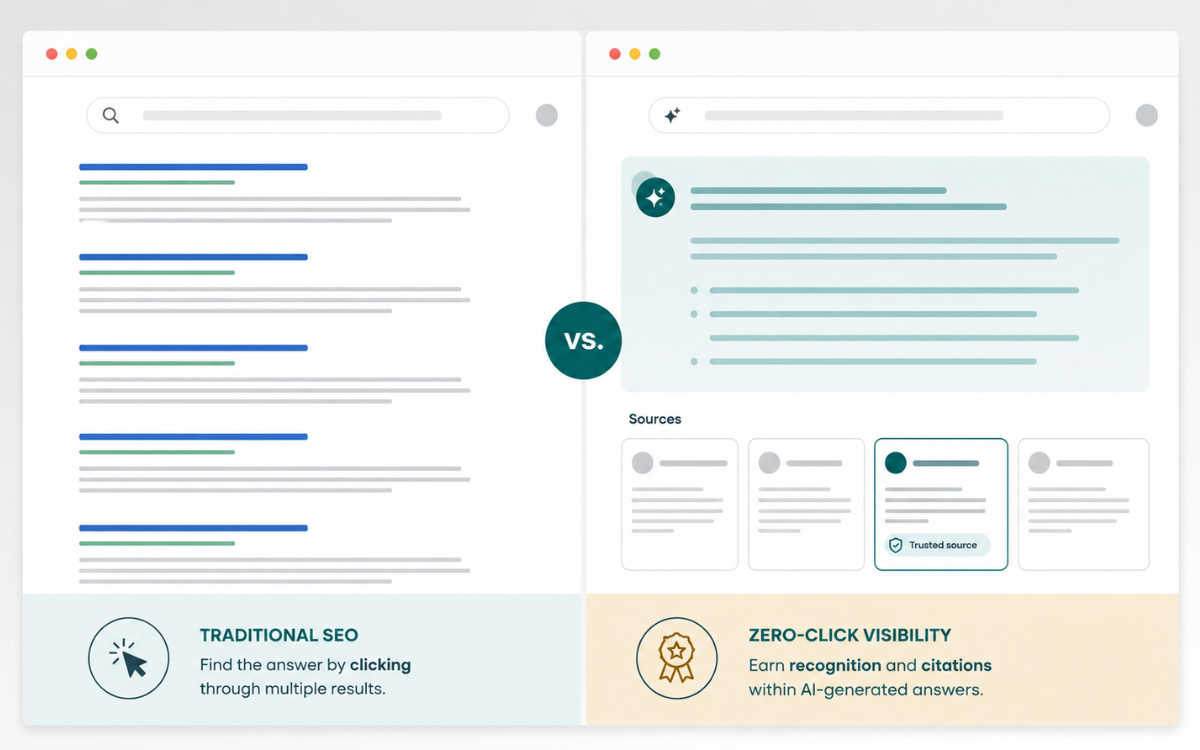
The left panel shows conventional search results designed to generate website clicks, while the right presents an AI-generated answer supported by source cards and a highlighted trusted citation. It illustrates the shift from traffic acquisition to brand recognition, authority and mindshare.
Creating un-googleable content
If an AI can summarise your article in ten seconds, your content was probably too generic to begin with. The only way to survive a zero-click world is to create content that cannot be replicated by a scraper.
We call this “un-googleable” content. It relies on elements that AI cannot synthesise:
- Proprietary data and original research: Run surveys, analyse your own platform data, and publish the findings. An AI can summarise your report, but it must cite your brand as the creator of that data.
- First-person narratives and case studies: Nobody can scrape your unique experience of failing to scale a business or solving a specific client bottleneck.
- Strong, distinct opinions: AI is notoriously polite and middle-of-the-road. It struggles with bold, expert perspectives that challenge industry norms.
Consider a regional logistics firm. They could write a generic blog on “How to optimise supply chains.” Or, they could publish a raw case study detailing how they cut delivery times by 40% during a local monsoon season, complete with internal chat screenshots and driver interviews. The former is easily summarised and forgotten. The latter is a brand-building asset.
Cultivating the direct-to-consumer relationship
Depending entirely on search engines for your audience is like building a house on rented land. When the landlord changes the algorithm, your business model collapses.
The antidote is simple: own your distribution.
You need to convert the casual searchers who do click into owned subscribers as quickly as possible.
- The high-value micro-tool: Instead of a generic ebook, offer an interactive calculator, a template, or a dashboard that requires an email address.
- The habit-forming newsletter: Turn your blog into a product. Give people a reason to expect your insights in their inbox every week.
- Private communities: Move your most engaged readers into spaces like Slack, Discord, or private forums where you can speak to them directly without an algorithmic gatekeeper.
The rise of the brand search
The ultimate measure of brand equity in a zero-click world is the “brand search.” This is when a user bypasses generic terms entirely.
Instead of searching for “best marketing automation software,” they search for “[Your Brand Name] automation features.”
When someone searches for your brand by name, Google cannot steal that click. The user wants you, not a generic answer.
To drive these searches, your off-page presence must be as strong as your on-page SEO. Podcast guest appearances, thought leadership on LinkedIn, and speaking at industry events all feed this engine. They create the spark of curiosity that leads to a direct search later on.
How to measure success when the clicks disappear
If you are still measuring your content marketing team solely on website sessions, you are setting them up to fail. You need a new dashboard for a zero-click world.
Start tracking these metrics to understand your true reach:
- Share of voice in AI search: How often is your brand cited in AI Overviews for your target keywords?
- Direct traffic growth: Are more people typing your URL directly into their browser?
- Brand search volume: Is the monthly search volume for your brand name increasing in Google Search Console?
- Qualitative attribution: Add a “How did you hear about us?” field to your signup forms. You will be surprised how often the answer is “I saw your name cited in an AI summary” or “Read your newsletter.”
Preparing your brand for the next search evolution
The search landscape is changing, but the core human desire remains the same. People still want answers they can trust from voices they recognise.
Zero-click searches are not a threat to brands with genuine authority. They are only a threat to the middle-tier content farms that relied on basic keyword matching to survive.
By focusing on deep expertise, proprietary insights, and direct audience relationships, you ensure your brand does not just survive the zero-click era—it thrives in it.