

You’ve got the strategy document. You’ve got the content calendar. You’ve even got the shiny new AI tools. Yet, month after month, the results feel… off. Leads are inconsistent. The brand voice wavers. Projects stall in review hell. The problem might not be what you’re creating, but who is creating it—and how they’re (or aren’t) set up to work together.
A brilliant content strategy is only as strong as the team structure executing it. Get the structure wrong, and you’re not just slowing down; you’re actively working against your own goals. Here’s how common team setups quietly sabotage strategy, and what to build instead.
When specialists work in silos, the brand voice fractures
Imagine a team where the blog writer never speaks to the social media manager. The video producer works off a separate brief. The SEO specialist lives in a different spreadsheet altogether. This is the classic “specialist silo” model.
It looks efficient on paper—everyone is an expert in their lane. In reality, it creates a fragmented customer experience. The tone of a LinkedIn post doesn’t match the helpfulness of a blog guide. A video script feels promotional while the corresponding whitepaper is deeply educational. The audience doesn’t see one coherent brand; they see a collection of disconnected content pieces.
The strategy calls for a unified “helpful expert” voice. The execution delivers a confusing mix of corporate, casual, and confusing.
Unclear ownership turns strategy into a game of telephone
Who actually owns the content strategy? Is it the marketing head? The content manager? An external agency? When ownership is vague, accountability evaporates.
Projects get handed off like a game of telephone. The strategist outlines a pillar page on “SME financial planning.” The writer interprets it as a general guide. The editor focuses on grammar, not strategic alignment. The designer makes it pretty. The social promoter shares a link with a clickbait hook. By the time it reaches the audience, the core strategic intent—to attract qualified SME founders in tier-2 cities—is lost in translation.
High-performing teams have a single, clear owner for each strategic goal. This person doesn’t do all the work; they ensure every handoff preserves the original intent. They’re the guardian of the “why” from brief to publication.
Reactive workflows drown out proactive planning
If your team’s default mode is “putting out fires,” your strategy is a hostage. This happens when structure is purely operational: a content manager assigns topics based on last week’s analytics, writers scramble to deliver, and everyone reacts to the latest trend or client ask.
The result? A calendar full of activity but no strategic arc. You might hit topical relevance, but you miss building topical authority. You chase viral formats but neglect the foundational guides that actually nurture leads. The strategy document gathers dust while the content treadmill spins.
The fix isn’t just a better calendar; it’s a structure that protects strategic time. This means dedicated blocks for research, pillar content creation, and repurposing—not just reactive production.
The “tool-first” team confuses software with skill
A common modern mistake is building a team around tools, not thinking. You hire an “AI content specialist” or a “SEO optimisation wizard” without first ensuring they understand your audience’s psychology, your business model, and your brand’s point of view.
Tools execute. They don’t strategise. A team optimised for tool usage will produce plenty of technically sound but strategically empty content. They’ll have perfect keyword density but miss the real questions keeping your buyers awake. They’ll generate content at scale but fail to build trust.
The most effective structures put strategic thinkers—people who can interpret data, understand buyer journeys, and craft narratives—at the centre. Tools then become multipliers for their insights, not replacements for them.
What a strategy-aligned structure actually looks like
So, what does a team structure that supports strategy look like? It’s less about rigid titles and more about clear roles and connections.
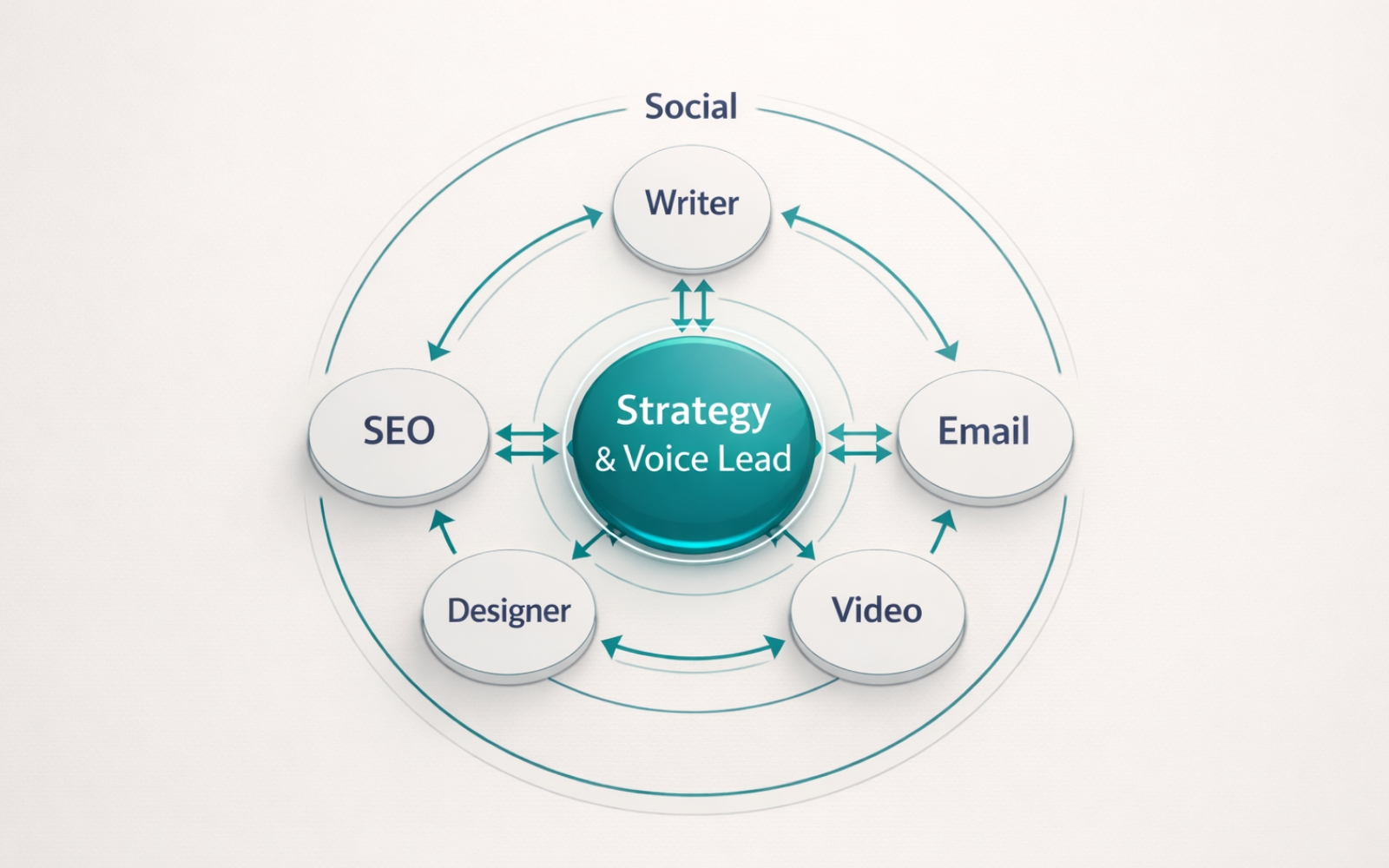
- 1. The strategy-voice hub: One person (or a very small core) owns the audience understanding, messaging framework, and content pillars. This is the source of truth for why we exist and who we talk to.
- 2. The specialist creators: Writers, designers, and video makers who are experts in their craft but are briefed from the strategic hub. Their job is to execute the vision with skill, not define it.
- 3. The channel integrators: Social media managers, SEO leads, and email marketers who don’t just “push” content. They adapt the core asset for their channel’s context while preserving the strategic message. They also feed performance data back to the hub.
- 4. Built-in feedback loops: Regular, structured syncs where data (from analytics) and insights (from sales, customer support) flow back to the strategy hub to inform the next cycle. This turns content from a broadcast into a conversation.
Building the structure that lets your strategy breathe
Fixing your team structure isn’t about org charts. It’s about intentional design.
- Start with the strategy, not the roles. Define your 3-5 core content pillars and the audience journey stages they serve. Then figure out what skills you need to bring them to life.
- Appoint a single “strategy guardian.” This isn’t necessarily a manager, but someone with the mandate and skill to protect the core message across all formats and channels.
- Design workflows backwards from the audience experience. map how a piece of pillar content becomes a social thread, an email sequence, and a sales enablement tool. Who touches it at each stage? How does the brief evolve?
- Bake in “strategy time.” protect 20-30% of your team’s capacity for learning, research, and planning—not just producing. If the calendar is 100% full, your strategy will always be someone’s afterthought.
Your content strategy is a living plan. Your team structure is the skeleton that either supports it or lets it collapse. Stop wondering why your brilliant strategy isn’t working. Look at the hands building it. Are they aligned, or are they pulling in different directions? the answer might just be the missing piece you’ve been searching for.